Apple designed its wonderful new (fast! private! thinking of the children!) Siri AI in a way that it knew contravened the EU Digital Markets Act. It expected the EU to let it break the law anyway, pinky-promising that it would make it compliant after 18 months. Understandably sceptical, after 2 years continued WebKit monopoly on iOS, EU said “no”. Not-Steve and Not-Steve-Either are both Very Sad (while still Thinking Of the Children).
Unfortunately, due to the Digital Markets Act (DMA), Apple will not be able to ship Siri AI in the European Union with the release of iOS 27 and iPadOS 27. Over the past several months, EU regulators did not accept any of Apple’s proposed solutions to bring Siri AI to the EU while safely supporting other virtual assistants.
sobbed Craig Federighi, Apple’s senior vice president of Software Engineering, lachrymosely. Dabbing his eyes and blowing his nose, Crying Craig blamed “EU regulators’ extreme interpretation of the DMA” which outrageously requires Apple to, er… obey legislation.
The decision not to roll out Siri AI in the EU is Apple’s and Apple’s only. Absolutely nothing in the DMA prohibits Apple from introducing new products in the EU. What Apple is, however, not allowed to do is to close the market. It’s not for them to choose which AI tools our EU citizens get to use or not. That’s not an option.
Because it would mean that no AI agent other than Siri AI, by the way, powered by Google, would have an equal chance to be chosen by iPhone users. Apple was simply unable to develop interoperability solutions that meet essential EU privacy and security standards.
And more importantly, and I will finish with this, EU law is non-negotiable.
Doubtless, Apple is preparing to leave EU and take their toys home, as they threatened 9 months ago. As a Brexit Benefit, the UK will be a huge marketplace for contraband devices with hallucinating robots protecting your Comfort and Security. And (of course) Thinking Of The Children.
Our towns will be filled with grief-stricken Europeans begging “S’il vous plaît, vendez-moi juste un téléphone fruité?“, “Hast du so ein bescheuertes Handy, das mir 30 % meines Geldes abknöpft?“, “Alstublieft, één apparaatje waarmee ik aan de kinderen kan denken!” or “¡Dame fruta robot brillante, hombre!”
Siri AI and the other new Apple Intelligence features will not be available in China while Apple works through regulatory requirements.
But that’s to be expected; China is always the exception, even when it comes to Apple’s “deep sense of responsibility to make technology for people that respects their human rights [and] empowers them with useful tools and information”.
It’s almost as if Apple fights regulators if it thinks it can continue making monopoly profit that way, but kowtows to authoritarians elsewhere if that’s where the money is.
Ad infinitum – “Google didn’t talk about ads in the I/O keynote. Everything they announced is the new ad system. One that, in the eyes of Google, no longer needs the open web as an intermediary … Google is betting its entire future on a world where people eagerly hand over their emails, their files, their habits, and their trust – to an AI system that will quietly auction off their attention, word by word, to the highest bidder.”
Six Characters – What the PNR locator on your boarding pass actually contains, and why the fare calculation line on your e-ticket is written in a currency that does not exist.
How sheep and solar power work together at the Volkswagen Chattanooga factory – “Adaptive grazing with sheep is an efficient and cost-effective way to control vegetation and minimize erosion risks on utility scale solar facilities … To help keep the sheep safe, Silicon Ranch Corp. employs “guard” donkeys to alert the sheep of any threatening wildlife.”
Last week the UK Competition and Markets Authority (CMA) launched its strategic market status investigation into Microsoft’s business software ecosystem. An investigation doesn’t necessarily imply that Microsoft has done anything wrong; it will examine Microsoft’s position in the markets and decide whether it is powerful enough to require “action to promote customer choice”.
This is A Good Thing. Doubtless vendors of video conferencing, email clients, and clown computing will have their own stories to tell of Microsoft’s self-preferencing, but I’m in the browser business, so here’s mine.
Three years ago the CEO of Vivaldi (my boss) wrote an open letter to the EU Commission expressing concerns over Microsoft’s anti-competitive practices. And since I joined Vivaldi in 2024, I’ve been working with other Windows browser vendors in the Browser Choice Alliance, making press and regulators aware of Microsoft’s dark patterns and deceptive practices.
We’ve managed to shame Microsoft into making some changes in the EU, although Microsoft Edge is still not designated a ‘Core Platform Service’ (CPS), so remains exempt from special obligations. (It was originally designated, but Microsoft appealed and it was un-designated [PDF] because “Edge’s scale of usage in the web browser CPS category is low” and “Microsoft’s ability to use Edge as a lever to drive usage of other Microsoft services is at present limited”.)
But, of course, the UK is no longer a member of the EU, so Microsoft continues to misbehave on this scepter’d isle. For example, Windows doesn’t respect the user’s chosen default browser when you do a search from the Windows Bottom Taskbar Thingy™. Here’s a video made Monday 18 May at 12.16pm, four minutes after a Windows update on a UK region Windows 11 machine, with Vivaldi set as the default web browser:
The important thing to note is that Windows starts Microsoft Edge when you initiate a search in Windows Bottom Taskbar Thingy™. It’s self-preferencing and this behaviour cannot be over-ridden (although you can override Bing as the default search in Edge).
Once upon a time you could use EdgeDeflector, a small application that intercepted URIs that force-open web links in Microsoft Edge and instead redirected it to the system’s default web browser (if you knew the utility existed, and knew how to get code from Github, and were allowed to install it on a corporate machine) but Microsoft sabotaged that.
Why does Microsoft make Windows do this? As with a shark or a werewolf, I can only speculate about the Beast Of Redmond’s primal urges, but every user that can be shown Bing search results is a chance to show more ads, and make more money. And, perhaps just as important to Microsoft, it’s money that’s not going to Google.
Now that “A.I.” is being pushed deeply into all Microsoft products, it is a great chance to get users away from Google’s Gemini and into Copilot – which will show you personalised ads and use your private data for training the next iteration of its LLM soothsayer.
If you don’t want ads to be personalized, simply adjust your ad settings … When you share information with Copilot it benefits your and others’ experiences by helping Copilot understand trending topics and common questions. You can always opt out.
Which means that unless you take evasive action, you’re being snooped on by default. You’re tracked in the browser; what you do in the search engine is spied on, and anything you let Copilot see is training data.
Fun fact: a lot of people pronounce Microsoft’s sparkling autocomplete as “Co-Pilot”, but it’s actually pronounced “Copy-Lot”. That’s because Mustafa Suleyman, CEO of Microsoft AI (“a division bringing together our major consumer AI products including Copilot, Bing, GroupMe, MSN and Edge”) believes
With respect to content that is already on the open web, the social contract of that content since the ’90s has been that it is fair use. Anyone can copy it, recreate with it, reproduce with it. That has been freeware, if you like.
Personally I don’t like. But they copy, lots. Hence the name.
Our Edge browser has taken share for 20 consecutive quarters, and Bing monthly active users reached 1 billion for the first time
As with other Big Tech wannabe monopolists, if dirty tricks work while regulators turn a blind eye, Microsoft has no reason to stop. In fact, it has millions of green-backed reasons to continue using its market dominance to restrict competition.
As always, the CMA are eager to hear opinions of UK businesses, or organisations that have customers in the UK. You can be as brief as you like (i.e., you don’t need to have an opinion on every facet of Microsoft’s software) and can remain anonymous. Comments close midnight on 4 June.
A Transformational Narrative for Stakeholders, Team Members, Ecosystem Participants, and Value-Adjoining Strategic Humans
At BruceLab, we believe the future is not merely arriving. It is onboarding itself asynchronously into an AI-enabled value stream.
Over the last several quarters, we have engaged in a deep-listening exercise with the market, our customers, shareholders, executive thought partners, and selected prompts inside GPT-4 Enterprise. Through this journey of intentional operational becoming, one thing has become radically clear:
The future of software engineering is no longer about writing software. It is about orchestrating outcomes across a dynamic intelligence fabric.
This is why today we are excited to announce the next chapter of BruceLab's transformational evolution:
BruceLab Act 2.1: Operationalizing Excellence Through AI-Native Human Capital Rationalization
This initiative positions BruceLab at the convergence of:
AI-first stakeholder enablement
decentralized decision acceleration
machine-scale ideation throughput
synergistic platformization
and people-adjacent innovation verticals
In practical terms, this means we will be:
reducing organizational drag coefficients
sunsetting legacy human workflows
flattening management topology surfaces
and empowering leaner, higher-bandwidth micro-teams to execute with founder energy
Some roles may transition into alumni status as part of this exciting optimization journey.
We do not view this as downsizing.
We view it as: Strategic Talent Realignment for the Agentic Era™
Our 12 Pillars of AI-Native Executional Velocity
After an intensive offsite facilitated by McKinsey, three keynote speakers from NVIDIA, and an AI-generated mural experience, we identified the twelve immutable truths of next-generation software delivery
1. Software will no longer be built by developers
Software will be manifested through probabilistic orchestration pipelines facilitated by context-aware autonomous digital entities.
Developers will continue adding value in areas where humans still temporarily outperform systems.
2. Every workflow is an AI workflow
If a process cannot be automated, it should at minimum become a dashboard.
3. Meetings are now deliverables
Going forward, all meetings under 30 minutes will be classified as “micro-sprints.”
4. Middle management is latency
By reducing management layers, we reduce conversational packet loss and increase accountability throughput.
5. Humans should focus on uniquely human activities
Examples include:
narrative amplification
trust signaling
strategic empathy
conference attendance
and re-prompting agents after failed outputs
6. AI agents are teammates
All agents will receive BruceLab handles and participate in retrospectives.
(Agents exceeding performance expectations may receive expanded token budgets.)
7. Every employee must maintain a prompt portfolio
Beginning Q3, performance reviews will include:
Prompt Quality Index (PQI)
AI Utilization Rate (AIUR)
Hallucination Recovery Velocity (HRV)
and Net Strategic Alignment Per Utterance (NSAPU)
8. Documentation is now self-healing
Documentation accuracy will be maintained through recursive AI summarization loops.
9. Code ownership is obsolete
In the future-state enterprise, code owns itself.
10. Customers crave autonomous experiences
Research indicates enterprise buyers increasingly prefer phrases like:
“AI-powered”
“agentic”
“self-optimizing”
and “governance-aware”
regardless of implementation specifics.
11. Burnout is a resilience opportunity
Team members are encouraged to leverage wellness synergies and growth mindset modalities during periods of accelerated transformation.
12. The future belongs to companies brave enough to say “agentic” 400 times
We intend to lead.
Operating Principles for the New Era
We are retiring our previous values framework and replacing it with a more execution-oriented system:
Speed with Optional Quality
Perfect is the enemy of shareholder value.
Radical Accountability
Every team member is now effectively a startup founder without corresponding equity implications.
Customer Obsession
We remain deeply committed to listening to customers before confidently ignoring their requests in favor of our AI roadmap.
Organizational Enhancements
To unlock maximal strategic agility:
teams will now consist of two humans and approximately eleven AI agents
all approvals will be replaced with confidence scoring
Jira tickets will be automatically generated, closed, reopened, reprioritized, and emotionally categorized by LLMs
several countries may be deprecated
PowerPoint usage will increase by 700%
Additionally, we are proud to launch:
BruceLab Duo Ultra Max Enterprise Infinity
This next-generation platform layer leverages:
multimodal orchestration matrices
autonomous DevSecFinOps observability
contextual token-efficient governance abstraction
and quantum-ready semantic pipeline harmonization
Pricing will combine:
subscriptions
consumption billing
surge pricing
and “outcome-aligned monetization moments”
Fervently Avoided Questions (FAQs)
Is this a layoff?
We prefer the term:
“Workforce topology modernization.”
Will AI replace engineers?
No. Engineers will continue playing a critical role in supervising AI systems until confidence thresholds improve materially.
Why does this document read like it was generated by AI?
We reject the premise of the question.
However, this communication was proudly co-created through a human-AI strategic storytelling partnership leveraging frontier narrative tooling.
Some paragraphs appear duplicated.
This is intentional redundancy for alignment reinforcement.
Some paragraphs appear duplicated.
This is intentional redundancy for alignment reinforcement.
Why are there random capitalization inconsistencies?
This is part of our new Dynamic Tone Authenticity initiative.
Final Thoughts
BruceLab is no longer simply a DevSecOps platform company.
We are becoming:
an intelligence coordination layer,
a software cognition substrate,
and a stakeholder-centric orchestration ecosystem for the post-human productivity frontier.
The future will belong to organizations capable of:
moving fast,
leveraging AI,
flattening hierarchies,
and generating visionary keynote decks containing glowing purple gradients.
We are excited for this next chapter. Next Act. Whatevs.
Please do not reply directly to this announcement thread because comments have been disabled for alignment purposes.
This reading list is courtesy of Vivaldi browser, who pay me decent money to fight for a better web and don’t moan at me for reading all this stuff. We’ve just released Vivaldi 7.9, with even more personalistion and zero “A.I.”, because it’s cream of the crop, not a stream of the Slop.
The end of responsive images – As another perp behind the ungainly responsive images syntax, I too feel Matttt Marquis’ pain, and say yay sizes=”auto” for lazyloaded images.
Roving Tabindex – A simple dependency-free HTML web component that implements the roving tabindex pattern for building accessible menus and grids
Talking of which… Google’s Prompt API – No web standard should require you to agree to an advertising company’s “terms of use”, says glamorous Matttt Marquis.
Under the hood of MDN’s new frontend – in which it is revealed that using React to serve essentially static content “accumulated quite a lot of technical debt”, and is better replaced by … Web Components and CSS, AKA “the web platform”. And also the revolutionary new concept of “Shipping only what’s required”.
How Many Bites at the Apple? – Gene Burrus, who headed up Microsoft legal after the landmark IE browser monopoly case, writes “Apple has again asked the Supreme Court in the United States to excuse its engagement in unfair methods of competition and contempt of court”
On Tuesday, the European Parliament presented the statutory review of the Digital Markets Act. So, naturally, I went to Strasbourg to tell politicians that as DMA has only really been in force for two years, it’s probably too early to make any amendments. And while it’s been quite successful so far, we really need the Commission to enforce it more vigorously. (Many MEPs agree; last week, the European Parliament’s Internal Market (IMCO) committee called for the “full and proactive use” of all the Digital Market Act tools, and encourage the EU to resist external political pressure.)
As an independent European browser, Vivaldi needs access to platform controlled by vendors of competing browsers. It’s ridiculous that Apple is still able to impose impossible conditions on anyone who wishes to use their preferred browser engines on i(Pad)OS, and that Microsoft is still able to self-preference its own Edge browser on Windows.
If Europe is to achieve real digital sovereignty, the EU needs to monitor compliance -not just believe the Gatekeepers marking their own homework- and have the courage to impose real sanctions against Big Tech’s attempts to smother European compeititors.
I arrived the evening before my meeting, so had a while to look around Strasbourg, which was pretty.
And while Strazzy is (currently) in France, it has a heartily Germanic side to its cuisine. My dinner comprised most of a pig cooked in beer, and about a kilo of roasted potatoes (plus a salad and some bread):
The European Parliament was cool, and it made me sad that the UK is no longer included. Whatever the British Right may think of the European Project, Europe hasn’t forgotten the contribution that Britain made to ensuring a democratic Europe.
Let’s hope Europe is courageous against modern fascists and their industrialist friends as it was 80 years ago.
This reading list is courtesy of Vivaldi browser, who pay me decent money to fight for a better web and don’t moan at me for reading all this stuff. We’ve just released Vivaldi 7.9, with even more personalistion and zero “A.I.”, because it’s cream of the crop, not a stream of the Slop.
HTML in canvas – “There’s a new WICG proposal that lets you render real, interactive HTML elements into a <canvas>. including WebGL and WebGPU contexts. I spent a few days building demos with it.”
Amazon is cutting off support for older Kindles – but don’t worry! Bountiful beneficent Bezos is “encouraging” you to buy a new one with a 20% discount, so just drop your old one in a canal, or hoik it at a baby eagle, or bash an otter to death with it. Or, if you’re really evil, you could jailbreak it so you can continue to read books you already own on a device you already own.
I Decompiled the White House’s New App – “The official White House Android app has a cookie/paywall bypass injector, tracks your GPS every 4.5 minutes, and loads JavaScript from some guy’s GitHub Pages”
The AI Great Leap Forward by Han Lee. “In 1958, Mao ordered every village in China to produce steel. Farmers melted down their cooking pots in backyard furnaces and reported spectacular numbers. The steel was useless. The crops rotted. Thirty million people starved.In 2026, every other company is having top down mandate on AI transformation.”
The whole world is on the streets, delirious with joy, as today one of the world’s largest companies turns 50 years old. The web is full of reminiscences about Apple products and Saint Steve, such as Apple at 50: My 10 most memorable moments. I haven’t been an Apple user for as long as many have, so here are my five top Apple memories.
The time Apple lied to the UK regulator
That hilarious time when Apple engineers added code to the Safari’s settings page to hide the option to change the default browser if Safari was the default, but then to prominently show it if another browser was the default. And then silently fixed it and lied to the UK regulator, pretending it never happened! Oh, how we all laughed.
The time when Apple told the EU that Safari is 3 different browsers
When Apple tried to shut the UK investigation down
Not-Steve’s minions went to the Competition Appeal tribunal and got the UK regulator’s Market Investigation Report dismissed, not by arguing before the tribunal that the CMA was substantially wrong about any of its anti-competitive behaviour, but on a legal technicality based around the timing of the opening of the investigation. This was reversed when the regulator went to the Court of Appeal. How we chuckled at Apple’s zillion dollar lawyers flushing taxpayers’ money down the iToilet!
When Apple’s VP of Finance got caught lying under oath
To hide the truth, Vice-President of Finance, Alex Roman, outright lied under oath. Internally, Phillip Schiller had advocated that Apple comply with the Injunction, but Tim Cook ignored Schiller and instead allowed Chief Financial Officer Luca Maestri and his finance team to convince him otherwise. Cook chose poorly. The real evidence, detailed herein, more than meets the clear and convincing standard to find a violation. The Court refers the matter to the United States Attorney for the Northern District of California to investigate whether criminal contempt proceedings are appropriate…
Apple employees attempted to mislead the Court by testifying that the decision to impose a commission was grounded in AG’s report. The testimony of Mr. Roman, Vice President of Finance, was replete with misdirection and outright lies.
The one when Apple tried to wreck all EU Web Apps
Apple doesn’t want PWAs to open in third-party browsers that have more powerful features than Safari, because those would directly compete with native apps in its own App Store. However, in the EU, it can’t privilege PWAs in Safari with its own private APIs any more. And so its solution, in its spirit of malicious compliance, was to break all PWAs in the EU, just before the Digital Markets Act came into force, and claim that the DMA required it.
“Contrary to Apple’s public representation, the removal of Home Screen Web Apps on iOS in the EU was neither required, nor justified, under the Digital Markets Act”, a commission spokesperson said.
Who knows what the next 50 years have in store for Not-Steve and his successors? I’m old enough to remember when it was inconceivable that behemoths like BlackBerry or Nokia could disappear. Now we think differently.
Meanwhile… Inside the far-right network targeting Europe’s digital rules – “The Trump administration and a network of far-right think tanks are increasingly targeting the EU’s digital regulations and rules on content moderation. Far-right MEPs have taken over these narratives, while tech companies are hoping to exploit the opportunity.”
North Carolina Man Pleads Guilty To Music Streaming Fraud Aided By Artificial Intelligence – He used Slop-generators to create hundreds of thousands of “songs”, and bots to stream those slongs billions of times, collecting $8m in royalties. It’s the perfect metaphor for late-stage capitalism: burning forests to generate fake songs to stream by robots that can’t hear, endlessly, while artists starve.
Google Just Patented The End Of Your Website – “a system that evaluates your company’s landing page in real time and, if it decides the page won’t perform well enough for a specific user, replaces it with an AI-generated version assembled on the fly. The user never sees what your team built, they see what Google’s machine learning model thinks they should see instead.”
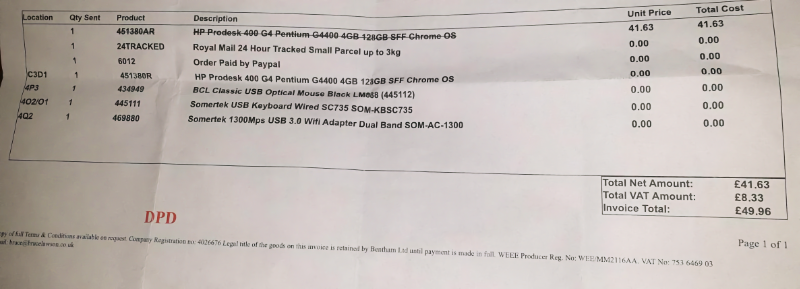
The other day, I was pruning my inbox when I noticed an email from a company that I occasionally buy print cartridges from, IJT Direct, offering a reconditioned PC, with a new USB keyboard, mouse, wifi dongle, all for £50–including tax and delivery. Last year I upcycled an eBay Windows machine for my mum with ZorinOS and Vivaldi browser, so naturally, I had to get a £50 desktop, just to try it out and see if I could run Vivaldi.
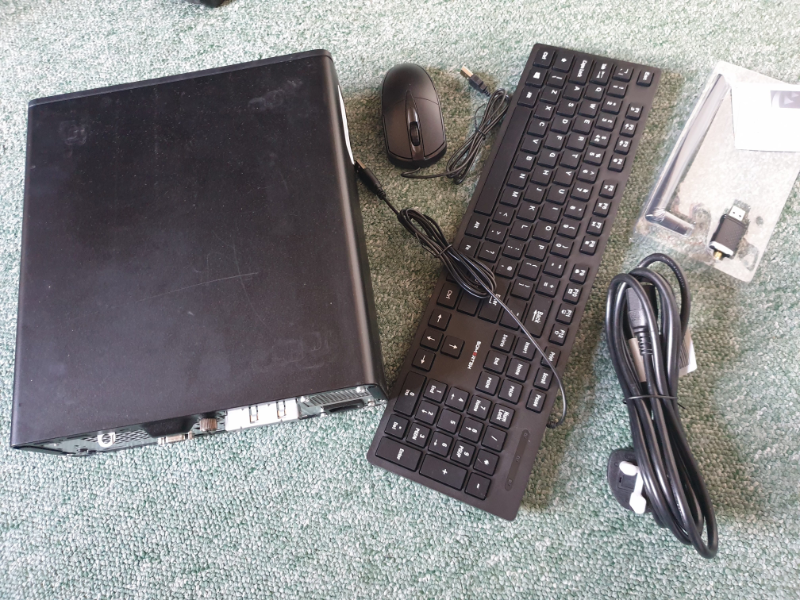
The set arrived.
The computer is an SFF PC Pentium G4400 “up to 3.30GHz Processor” with 4GB RAM and a 128GB SSD. Beautiful it is not. But, like me, it’s ugly and old, yet still capable of being useful.
I found myself an old VGA cable, and plugged it all in. It booted very fast, to something called ChromeOS Flex. ChromeOS Flex does not support Android apps, but it should support the Linux development environment. Of course, you have to sign in with a Google account, so I duly did, and after the OS updated itself, I went to Settings > About ChromeOS > Developers to set up Linux.
Yikes. The whole option was greyed-out. A bit of digging later, and I realised that the machines needed to be set up for Virtualisation in order to set up Linux. Was it? I would need to go to the BIOS to find out. Unfortunately, all tutorials told me that to go to the BIOS I needed to power up while pressing the Chromebook’s Refresh key–but this isn’t a Chromebook, so there was no refresh key.
Through trial and error (starting up while holding Esc) I entered the BIOS, mooched around until I saw “virtualisation” was off, turned it on, booted into ChromeOS Flex and, lo and behold! I was able to set up the Linux development environment.
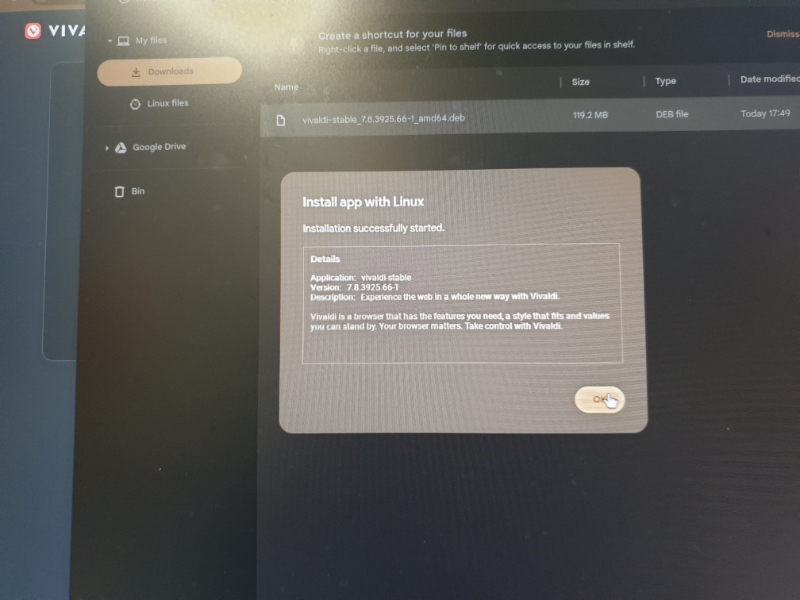
Then, it was a simple matter of going grabbing the Debian-flavoured Vivaldi and installing it with Linux (which ChromeOS offered to do automatically):
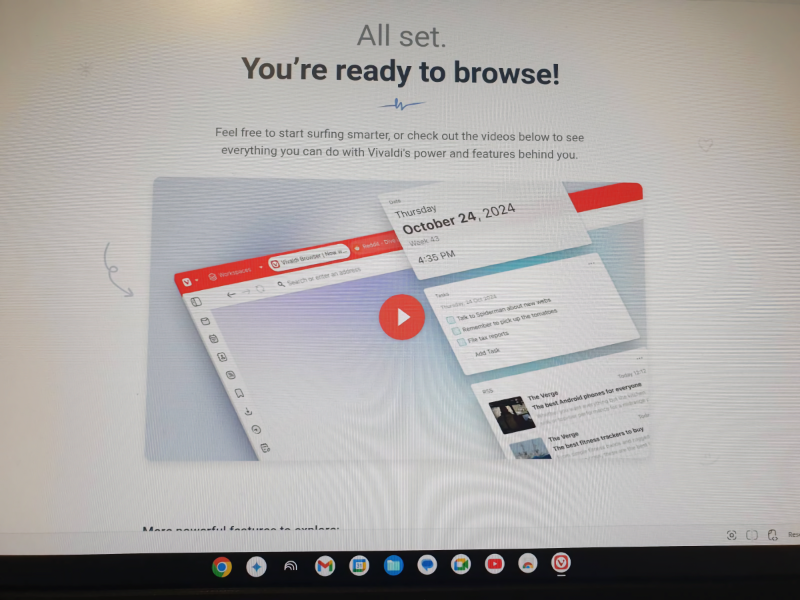
And then Vivaldi is installed and available in the task bar, like any of ChromeOS’s pre-installed apps. You don’t have to do anything fancy, like start Linux and then start Vivaldi within that. It takes a few seconds to start after the machine is booted up; I assume this is because it has to boot up the Linux environment beforehand. If I quit Vivaldi, and restart it, it’s immediate.
It runs pretty well, considering it only has 4 GB of RAM. YouTube videos play properly (I wondered about codecs etc) and video conferencing is fine. The only thing that prevents Vivaldi being a “full citizen” is that ChromeOS doesn’t respect setting it as the default browser. I assumed this is because Linux is a sub-system (from the “Start button”, all Linux apps are displayed together in a folder called “Linux Apps”, while pre-installed ones are shown separately). However, when I installed LibreOffice with Linux and clicked a link in a document, the link still opened in Chrome.
It’s not the most elegant of machines, and isn’t portable, but it would do the trick for someone who wants a desktop rather than a laptop for civilian computer tasks: emails, YouTube, shopping, paying bills, social networking, writing the occasional documents (which is probably the majority of PC users).
And, for very little money, it’s prolonged the life of a perfectly usable machine and saved it from landfill. Hurrah.