A Transformational Narrative for Stakeholders, Team Members, Ecosystem Participants, and Value-Adjoining Strategic Humans
At BruceLab, we believe the future is not merely arriving. It is onboarding itself asynchronously into an AI-enabled value stream.
Over the last several quarters, we have engaged in a deep-listening exercise with the market, our customers, shareholders, executive thought partners, and selected prompts inside GPT-4 Enterprise. Through this journey of intentional operational becoming, one thing has become radically clear:
The future of software engineering is no longer about writing software. It is about orchestrating outcomes across a dynamic intelligence fabric.
This is why today we are excited to announce the next chapter of BruceLab's transformational evolution:
BruceLab Act 2.1: Operationalizing Excellence Through AI-Native Human Capital Rationalization
This initiative positions BruceLab at the convergence of:
AI-first stakeholder enablement
decentralized decision acceleration
machine-scale ideation throughput
synergistic platformization
and people-adjacent innovation verticals
In practical terms, this means we will be:
reducing organizational drag coefficients
sunsetting legacy human workflows
flattening management topology surfaces
and empowering leaner, higher-bandwidth micro-teams to execute with founder energy
Some roles may transition into alumni status as part of this exciting optimization journey.
We do not view this as downsizing.
We view it as: Strategic Talent Realignment for the Agentic Era™
Our 12 Pillars of AI-Native Executional Velocity
After an intensive offsite facilitated by McKinsey, three keynote speakers from NVIDIA, and an AI-generated mural experience, we identified the twelve immutable truths of next-generation software delivery
1. Software will no longer be built by developers
Software will be manifested through probabilistic orchestration pipelines facilitated by context-aware autonomous digital entities.
Developers will continue adding value in areas where humans still temporarily outperform systems.
2. Every workflow is an AI workflow
If a process cannot be automated, it should at minimum become a dashboard.
3. Meetings are now deliverables
Going forward, all meetings under 30 minutes will be classified as “micro-sprints.”
4. Middle management is latency
By reducing management layers, we reduce conversational packet loss and increase accountability throughput.
5. Humans should focus on uniquely human activities
Examples include:
narrative amplification
trust signaling
strategic empathy
conference attendance
and re-prompting agents after failed outputs
6. AI agents are teammates
All agents will receive BruceLab handles and participate in retrospectives.
(Agents exceeding performance expectations may receive expanded token budgets.)
7. Every employee must maintain a prompt portfolio
Beginning Q3, performance reviews will include:
Prompt Quality Index (PQI)
AI Utilization Rate (AIUR)
Hallucination Recovery Velocity (HRV)
and Net Strategic Alignment Per Utterance (NSAPU)
8. Documentation is now self-healing
Documentation accuracy will be maintained through recursive AI summarization loops.
9. Code ownership is obsolete
In the future-state enterprise, code owns itself.
10. Customers crave autonomous experiences
Research indicates enterprise buyers increasingly prefer phrases like:
“AI-powered”
“agentic”
“self-optimizing”
and “governance-aware”
regardless of implementation specifics.
11. Burnout is a resilience opportunity
Team members are encouraged to leverage wellness synergies and growth mindset modalities during periods of accelerated transformation.
12. The future belongs to companies brave enough to say “agentic” 400 times
We intend to lead.
Operating Principles for the New Era
We are retiring our previous values framework and replacing it with a more execution-oriented system:
Speed with Optional Quality
Perfect is the enemy of shareholder value.
Radical Accountability
Every team member is now effectively a startup founder without corresponding equity implications.
Customer Obsession
We remain deeply committed to listening to customers before confidently ignoring their requests in favor of our AI roadmap.
Organizational Enhancements
To unlock maximal strategic agility:
teams will now consist of two humans and approximately eleven AI agents
all approvals will be replaced with confidence scoring
Jira tickets will be automatically generated, closed, reopened, reprioritized, and emotionally categorized by LLMs
several countries may be deprecated
PowerPoint usage will increase by 700%
Additionally, we are proud to launch:
BruceLab Duo Ultra Max Enterprise Infinity
This next-generation platform layer leverages:
multimodal orchestration matrices
autonomous DevSecFinOps observability
contextual token-efficient governance abstraction
and quantum-ready semantic pipeline harmonization
Pricing will combine:
subscriptions
consumption billing
surge pricing
and “outcome-aligned monetization moments”
Fervently Avoided Questions (FAQs)
Is this a layoff?
We prefer the term:
“Workforce topology modernization.”
Will AI replace engineers?
No. Engineers will continue playing a critical role in supervising AI systems until confidence thresholds improve materially.
Why does this document read like it was generated by AI?
We reject the premise of the question.
However, this communication was proudly co-created through a human-AI strategic storytelling partnership leveraging frontier narrative tooling.
Some paragraphs appear duplicated.
This is intentional redundancy for alignment reinforcement.
Some paragraphs appear duplicated.
This is intentional redundancy for alignment reinforcement.
Why are there random capitalization inconsistencies?
This is part of our new Dynamic Tone Authenticity initiative.
Final Thoughts
BruceLab is no longer simply a DevSecOps platform company.
We are becoming:
an intelligence coordination layer,
a software cognition substrate,
and a stakeholder-centric orchestration ecosystem for the post-human productivity frontier.
The future will belong to organizations capable of:
moving fast,
leveraging AI,
flattening hierarchies,
and generating visionary keynote decks containing glowing purple gradients.
We are excited for this next chapter. Next Act. Whatevs.
Please do not reply directly to this announcement thread because comments have been disabled for alignment purposes.
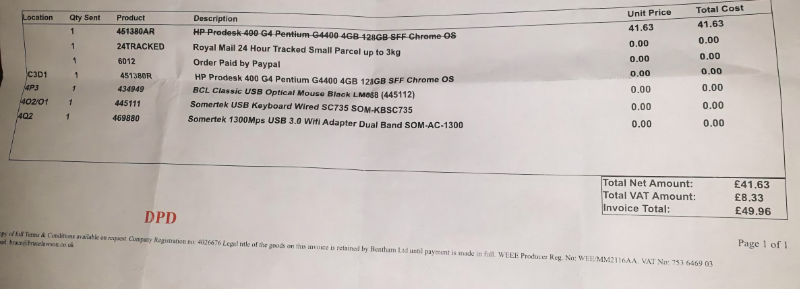
The other day, I was pruning my inbox when I noticed an email from a company that I occasionally buy print cartridges from, IJT Direct, offering a reconditioned PC, with a new USB keyboard, mouse, wifi dongle, all for £50–including tax and delivery. Last year I upcycled an eBay Windows machine for my mum with ZorinOS and Vivaldi browser, so naturally, I had to get a £50 desktop, just to try it out and see if I could run Vivaldi.
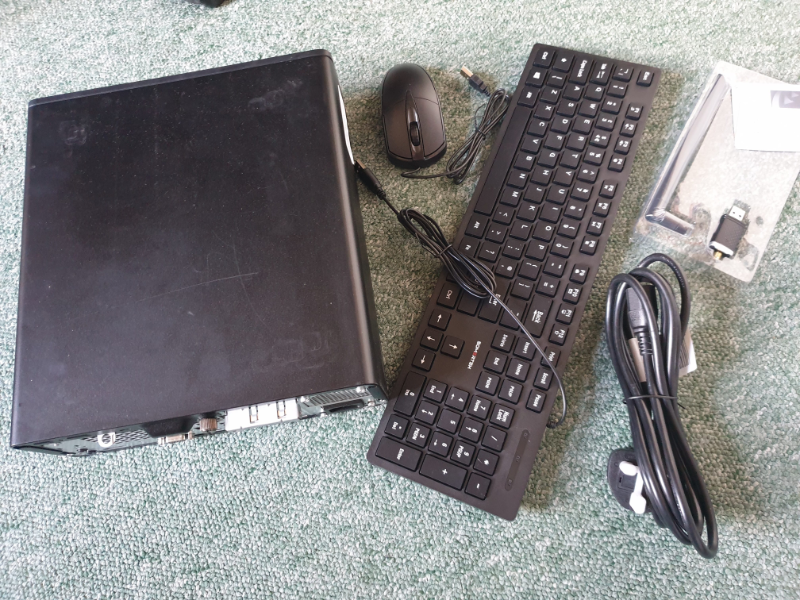
The set arrived.
The computer is an SFF PC Pentium G4400 “up to 3.30GHz Processor” with 4GB RAM and a 128GB SSD. Beautiful it is not. But, like me, it’s ugly and old, yet still capable of being useful.
I found myself an old VGA cable, and plugged it all in. It booted very fast, to something called ChromeOS Flex. ChromeOS Flex does not support Android apps, but it should support the Linux development environment. Of course, you have to sign in with a Google account, so I duly did, and after the OS updated itself, I went to Settings > About ChromeOS > Developers to set up Linux.
Yikes. The whole option was greyed-out. A bit of digging later, and I realised that the machines needed to be set up for Virtualisation in order to set up Linux. Was it? I would need to go to the BIOS to find out. Unfortunately, all tutorials told me that to go to the BIOS I needed to power up while pressing the Chromebook’s Refresh key–but this isn’t a Chromebook, so there was no refresh key.
Through trial and error (starting up while holding Esc) I entered the BIOS, mooched around until I saw “virtualisation” was off, turned it on, booted into ChromeOS Flex and, lo and behold! I was able to set up the Linux development environment.
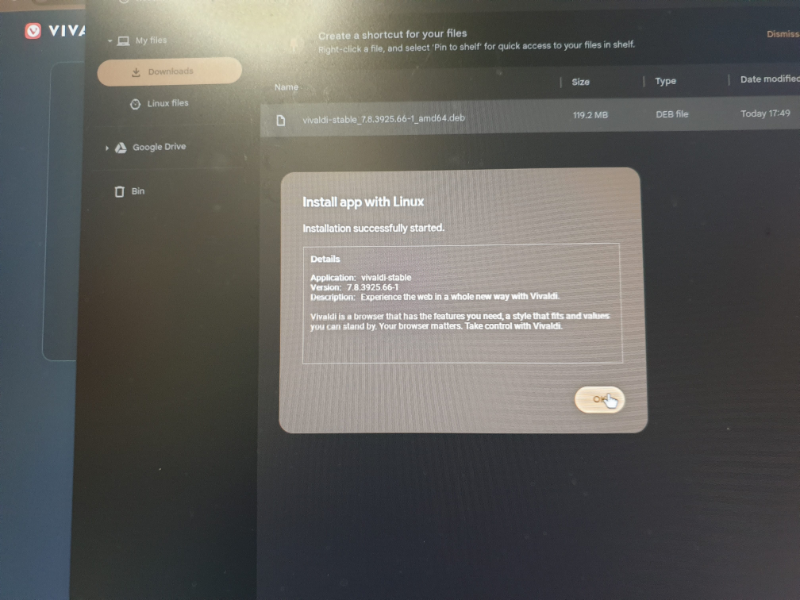
Then, it was a simple matter of going grabbing the Debian-flavoured Vivaldi and installing it with Linux (which ChromeOS offered to do automatically):
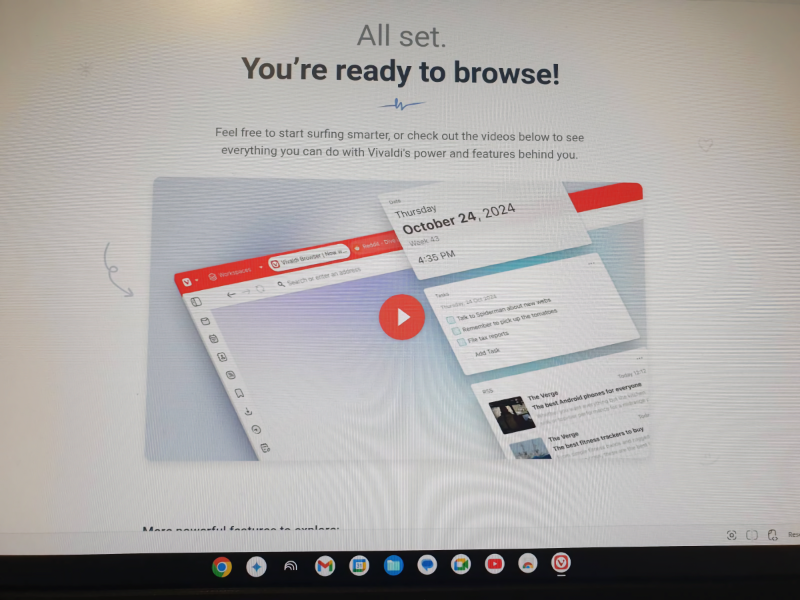
And then Vivaldi is installed and available in the task bar, like any of ChromeOS’s pre-installed apps. You don’t have to do anything fancy, like start Linux and then start Vivaldi within that. It takes a few seconds to start after the machine is booted up; I assume this is because it has to boot up the Linux environment beforehand. If I quit Vivaldi, and restart it, it’s immediate.
It runs pretty well, considering it only has 4 GB of RAM. YouTube videos play properly (I wondered about codecs etc) and video conferencing is fine. The only thing that prevents Vivaldi being a “full citizen” is that ChromeOS doesn’t respect setting it as the default browser. I assumed this is because Linux is a sub-system (from the “Start button”, all Linux apps are displayed together in a folder called “Linux Apps”, while pre-installed ones are shown separately). However, when I installed LibreOffice with Linux and clicked a link in a document, the link still opened in Chrome.
It’s not the most elegant of machines, and isn’t portable, but it would do the trick for someone who wants a desktop rather than a laptop for civilian computer tasks: emails, YouTube, shopping, paying bills, social networking, writing the occasional documents (which is probably the majority of PC users).
And, for very little money, it’s prolonged the life of a perfectly usable machine and saved it from landfill. Hurrah.
Like every other thought-leader, I follow Mike Taylr on social media. Ever since Shingy left AOL, “Mikey” has moved to the top spot of everyone’s Twitter “Futurist Gurus” Twitter list. This morning I awoke to read Twitter abuzz with exictement over Mike’s latest Nolidge Bom:
new interview question: on a whiteboard, re-implement the following in React (using the marker color of your choice) pic.twitter.com/o6F1iMzhQY
Of course, like anyone who’s ever sat a maths exam and been told to “show your working out”, you know that the widely diverse interview panel of white 20-ish year old men is as interested in how you arrived at your answer as in the answer itself. Given Mikey’s standing in the industry and the efficiency of his personal branding consultants, this question will soon be common for those interviewing in Big Tech, as it’s an industry that prides itself on innovative disruption by blindly copying each other. So let’s analyse it.
It’s obvious that the real test is your choice of marker colour. So, how would you go about making the right decision? Obviously, that depends where you’re interviewing.
If you’re interviewing for Google or one of its wannabes, simply set up a series of focus groups to choose the correct shade of blue.
If you’re interviewing for Apple or its acolytes, sadly, white ink won’t work on a whiteboard, no matter how aesthetically satisfying that would be. So choose a boring metallic colour and confidently assert any answer you give with “I KNOW BEST”.
If you’re interviewing for Microsoft, the colour doesn’t matter; just chain the marker to the whiteboard and say “you can’t change the marker, it’s an integral part of the whiteboard”, even after it stops working.
If you’re interviewing for Facebook or one of its wannabes, trawl through previous posts by the panellists, cross reference it with those of their spouses, friends and their friends to find their favourite colours, factor in their Instagram posts, give a weighting to anything they’ve ever bought on a site they’ve signed in using Facebook, and use that colour while whispering “Earth is flat. Vaccines cause cancer. Trump is the saviour. Muslims are evil. Hire me” subliminally over and over again.
Good luck in the new job! May your stocks vest well.
“Look, it’s perfectly simple. Go back to work, but don’t use public transport. Travel in a chauffeur-driven ministerial limousine. Use common sense – under no circumstances shake hands with people you know to have the virus. Covid-19 appeared in December, which makes it a Sagittarius, so Taureans and Libras should wear masks. But it also appeared in China, which makes it a Rat, so anyone called Mickey or Roland is advised to wear gloves. We’re following the science, so here’s a graph.
Remember, this is Blighty, not a nation of Moaning Minnies, Fondant Fancies or Coughing Keirs (thanks, Dom!). England expects every interchangeable low-paid worker and old person in a care home to Do Their Duty: let’s just Get Dying Done. God save the Queen, Tally-ho!”
The BBC has a report on Some of the funniest out-of-office replies. It’s a summertime filler story but I noticed them quoting Tyler Brûlé who wrote an article suggesting that people who set out-of-office messages simply aren’t committed enough. This is another example of “presenteeism”, one of the reasons that British workers don’t take time off sick when they’re ill.
I love my holidays; I work to live, not live to work, although I do love what I do. So I always set an Out of Office message on my employer’s corporate email. I’ve noticed through various jobs that most of the email I receive is either ephemera (“I’ll be late today”/ “Please note the fridge will be emptied on Thursday”) or conversations that go on for a few days, and then resolve themselves.
So my out of office says “I’m out until DD/MM/YYYY. If your message remains important when I return, please re-send it then, as I will delete all messages received before that date without reading”. And, apart from messages from direct bosses, I do just that.
Feel free to use my personal email out-of-office as inspiration:
OFF THE GRID!
I love you. I really do. The way your cute nose goes all crinkly when you smile – I dream about it and sigh. The way you toss your beautiful hair when you’re materialising from hyperspace makes my heart go pit-a-pat and skip a beat. Thinking of how your tentacles encircle my exoskeleton causes … well, let’s not go there.
But that doesn’t change the fact that I’m backpacking around India at the moment, and connectivity is limited. And there’s loads of stuff to look at that’s cooler than email, so it may take time until I reply. Until we see each other again, I yearn for your gentle caress and to hear the ethereal howling you make when extruding your egg sacs.
CUDDLES. xxx
Relax! Read a book! Go swimming! Play guitar! Get drunk! Learn karate! Do some yoga! Play tennis! Make love! Have fun with your friends and family! Remember, the graveyard is full of indispensable people.
Public service announcement: it’s good to eat Mars bars straight from the freezer, but don’t try it with a Crunchie: freezing makes them totally brittle and they turn into dust. I ate all the dust I could scoop off my shirt, but had to sweep 50% of it off the floor.
Caramac will be fine … I’d be very careful with Turkish Delight though and only a fool would try to freeze a large bar of Dairy Milk Marvellous Creations Jelly Popping Candy. You better know yourself if you’re going to mess with that.
My recent upgrade to Yosemite appeared to go without a hitch, until I fired up Garageband to tidy up the guitar line on my cello and harpsichord-driven song Girl In The Room.
To my dismay, the cello and harpsichord samples had disappeared, to be replaced by a very clunky generic synthesiser sound. After some investigation, it appeared that the new OS (or new Garageband 10.0.3) had nuked the soundfonts I’d put in Library/Audio/Sounds/Banks/. Perhaps I should have known this – but I’m new to Mac, and my experience on Windows is that it doesn’t hose your data when you upgrade. Ah well. Apple knows best, of course.
But, once I’d got the soundfonts from a backup and restored them to the correct folder, I’ve noticed that Garageband doesn’t see all of them. Other times, it sees a soundfont, lets me associate it with a track and plays it fine. Then I hit play again and the same track I heard seconds before is entirely silent although the dialogue box still claims the soundfont is associated with the track. (and what is a “user define bank”? User-defined, surely?)
This basically means Garageband isn’t usable for me with soundfonts (which was the whole purpose of my buying it; I don’t want to be restricted to the excellent-quality but rather middle-of-the-road default samples).
But I’m a Mac/ GB n00b and am probably missing something obvious. Anyone got any advice?
I’m trying to do my self-assessment tax form. I’m not a stupid man, so it shouldn’t be too hard (and I got a grade B Maths O Level in 1983!) and I want to be fair and pay my share. My salary is PAYE but I have a small amount of extra income from a book I wrote 4 years ago – and, as it’s a tech book, it’s quite old so the sums are small.
That, plus derisory rates of interest from money I save (as breadwinner in a Hard Working British Family™, I save for a rainy day) means I have to fill in a form. Once again, it’s defeated me. Why, for example, do I have to tell them how many dollars I was paid in royalties? The money hits my bank in pounds, so I note it down like a good boy in pounds so I can pay income tax on it in pounds. So I can’t fill that bit in. How do I record my ISA savings which are tax free (there’s only a place to record net interest and gross interest).
The whole thing seems like a conspiracy to create jobs for accountants. I have nothing against accountants (except for my karate sparring partner Mohammed, because he’s loads better than me), but I shouldn’t need a professional to record a few hundred quid in book royalties and ISA interest.
And the website is so shockingly rubbish it’s embarrassing to be in the web industry.
So, tomorrow, like every other bloody year, I’ll call their overloaded phone help line and be coached through the form, at great expense to the tax payer.
I don’t usually follow recipes from magazines, because they usually need zillions of ingredients and take ages to prep. But I had six people around for dinner, and a whole leg of lamb, so Hugh Fearnley-Whittingstall’s Six-hour spiced lamb with 40 cloves of garlic seemed a good choice. (All of us like garlic, but it’s not actually death-by-alium, as you don’t crush the garlic, just add it to the juices.)
It took about 10 minutes longer to prepare than any other roast, and that was toasting the spices and pulversising them in a pestle and mortar, but it was time well spent as it was absolutely delicious.
It did list some ingredients I didn’t have, so I adapted it thus:
For the sauce, I didn’t have paprika, caraway or fennel. So I added a couple of cloves, and some chilli flakes (about a teaspoon).
After the first 30 minutes, when you’re supposed to add a cup of water, I added a mug of water and a cup of red wine. (I knew my guests would want lots of gravy.)
An hour before the end, when you add all the garlic, I also added a couple of sprigs of rosemary from the garden, a couple of handfulls of black olives, and another cup of wine.
The gravy was really intense, even before I squished some cloves of garlic and a few olives into it and sieved it. The remaining olives tasted great for people to munch while the meat was resting. I served it with carrots that I cooked around the lamb for the last hour, potatoes roasted in goose-fat, Yorkshire puddings, roast butternut squash and boiled broccoli and cauli.